
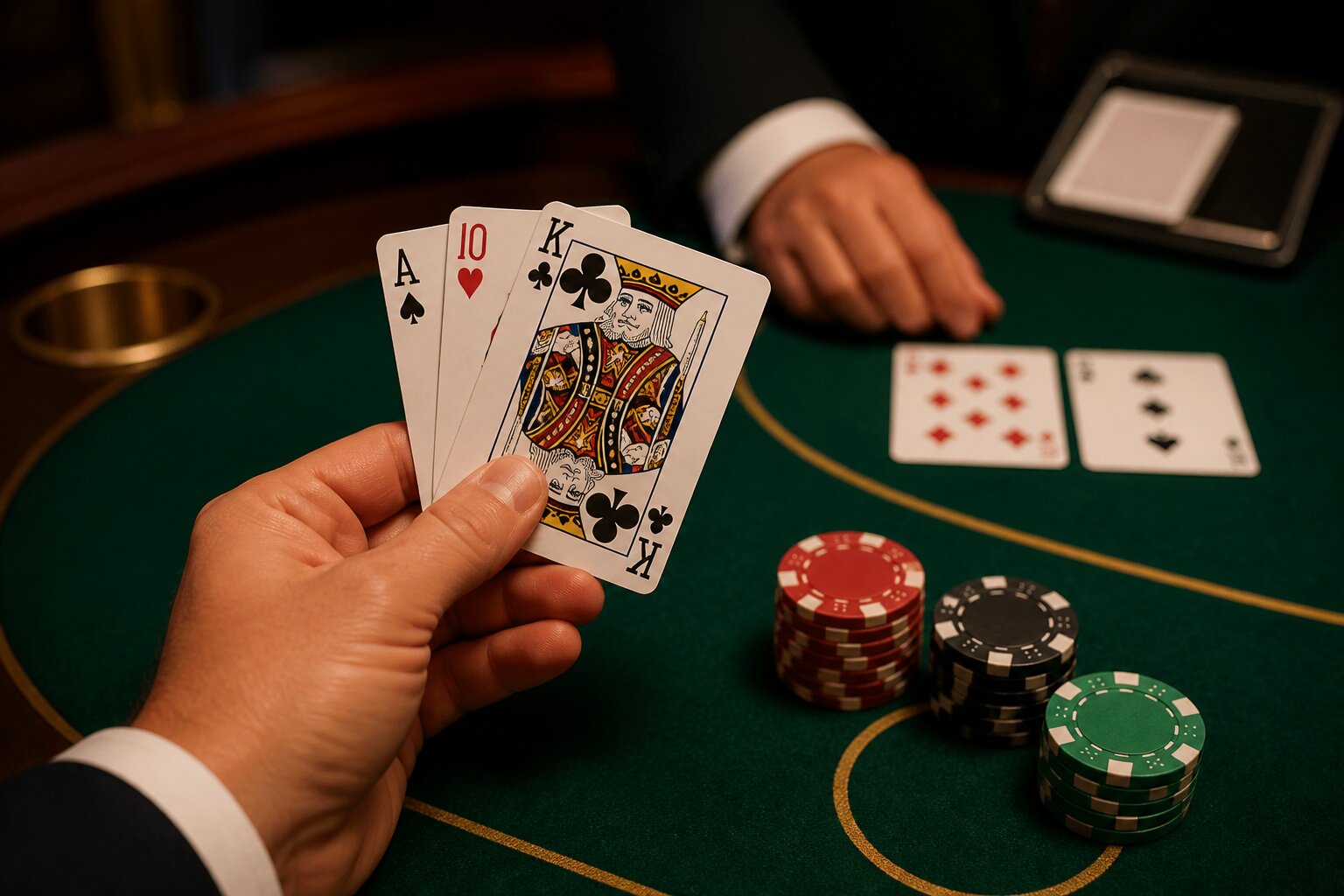
Ever wondered why some players seem to breeze through a game of blackjack, calmly making decisions while the rest of the table hesitates? Much of it comes down to knowing what every card is worth and how those values combine to reach 21.
If you’ve ever paused at the table, unsure how to count a mixed hand of face cards, aces and numbers, this guide will make the maths quick and intuitive so you can act with confidence and clarity.
Read on to learn the key rules that govern every decision you’ll face, and how those rules shape what comes next in play.
Understanding Standard Blackjack Card Values
Each card in a standard blackjack deck has a fixed point value that you add together to form your hand total. Number cards 2 through 10 count at face value, while face cards such as Jack, Queen and King are worth 10 points each. The Ace is flexible and can count as either 1 or 11 depending on which value suits your hand best.
These simple rules are the foundation for every decision at the table, whether a player chooses to hit, stand or double down. Knowing the basic values makes it possible to work out totals quickly and to judge risk, for example recognising when a hand is already strong or when another card could push the total over 21.
Because the Ace can take two values, it creates what are known as soft and hard hands. A soft hand contains an Ace counted as 11 and cannot be busted by taking one more card; for instance Ace plus 6 can be treated as 7 or 17. A hard hand either contains no Ace or has an Ace counted as 1, so the total is less flexible. Multiple Aces are treated to avoid busting where possible, with additional Aces usually counted as 1 to keep the total manageable. Next, we will look more closely at how to apply the Ace’s flexibility in different situations.
What Is the Value of an Ace in Blackjack?
The Ace’s ability to count as 1 or 11 makes it unique. It’s treated as 11 when that keeps the hand at 21 or below; if counting it as 11 would push the hand over 21, it converts to 1. For example, an Ace with a 9 can be 20 (Ace=11), but if a 5 is drawn the Ace becomes 1 so the total becomes 15 rather than busting.
When a hand includes multiple Aces, one is considered as 11 where possible and the others as 1, unless that arrangement still causes a bust. This automatic flexibility prevents a hand from breaking unnecessarily and gives more room to take extra cards when appropriate. Understanding this behaviour helps you judge risk more accurately and prepares you for how soft hands differ from hard ones.
Explaining Hard and Soft Hands
Hands are described as ‘soft’ when they include an Ace that can still count as 11 without busting. A soft 17, for example, is Ace + 6; drawing another card won’t automatically ruin the hand because the Ace can revert to 1 if needed. That gives the player a safety buffer compared with a hard hand.
A ‘hard’ hand either contains no Ace or contains an Ace that must count as 1 to keep the total at or below 21. Hard totals are less forgiving when taking additional cards, as there is no automatic fallback to avoid a bust.
Knowing whether a hand is hard or soft changes how to view the risks of drawing another card. To get a clearer sense of how these hands add up in practice, the next section shows common combinations you’ll encounter.
Common Hand Combinations & Their Totals
Recognising common combinations speeds mental arithmetic at the table and helps you spot which totals are strong or vulnerable. Familiarity with typical hands also reduces decision time and the chance of errors when the game moves quickly.
Typical examples include:
- 10 + 9 = 19
- Jack + 7 = 17
- Queen + 8 = 18
- Ace + 8 = 19 (soft 19)
- Ace + 6 = 17 (soft 17)
- Ace + 7 = 18 (soft 18)
- Ace + King = 21 (blackjack)
- 7 + 7 = 14
- 8 + 3 + 7 = 18
- 5 + 6 + 10 = 21
- Ace + 3 + 5 = 19 (Ace counts as 11 here)
- 2 + 2 + 9 = 13
- 10 + 2 + 6 = 18
These combinations show how different cards interact and illustrate the role of Aces and face cards in shaping totals. Face cards are always worth ten, number cards keep their pip value, and Aces can be either one or eleven depending on which gives the better total without busting.
With this familiarity, recognising your hand’s strength becomes almost automatic. That makes it easier to follow basic strategy and reduces the time you spend hesitating over straightforward choices.
Face Cards and Number Cards Explained
Face cards (Jack, Queen, King) are always 10 points regardless of suit, while number cards are worth their printed value from 2 to 10. Suits do not affect the point values, so a heart, diamond, club or spade of the same rank carries the same score. This consistency makes them the easiest part of the counting process and means most hands are straightforward to total once you handle any Ace values.
Because the values are fixed and uniform, beginners can usually add up most hands quickly without worrying about suits or special cases. Knowing that all face cards count as 10 removes one common source of confusion and helps keep running totals simple in most situations.
With the basic values clear, the method for adding up any hand is simply the next piece to follow.
How to Calculate Your Hand Value in Blackjack
Calculating a hand is a matter of summing the values described earlier. Start by adding number cards at face value and adding 10 for each face card. Treat an Ace as 11 if the total stays at or below 21; otherwise count it as 1. If there are several Aces, arrange one as 11 only when it doesn’t cause a bust; the rest count as 1.
For example, King + Ace + 3 initially looks like 10 + 11 + 3 = 24, but the Ace will be treated as 1 so the true total is 14. Whenever you draw an extra card, re-evaluate any Aces so the hand’s total remains the highest possible without exceeding 21.
Having covered how to add hands, it helps to see how special outcomes are treated at the table and what they mean for a round.
Special Cases: Blackjack, Busting & Dealer Outcomes
A blackjack is a two-card 21 formed by an Ace and any 10-point card dealt as the initial hand; it is treated differently from a regular 21 in terms of payout and priority. Busting occurs when a hand exceeds 21 and is immediately out for that round. The dealer follows fixed rules—typically drawing until reaching at least 17—so player decisions are judged against that predictable behaviour.
When the dealer busts, any remaining player hands that have not busted win; if the dealer finishes between 17 and 21, player hands are compared directly to that total. These mechanics define outcomes for every round and underline why accurate card counting and an understanding of hard versus soft hands matter in making sensible decisions.
Keeping play measured and within personal limits helps you enjoy the game without unnecessary risk.
Play Online Casino Games at New Online Slots
We’re delighted to invite you to enjoy everything our site has to offer. Experience the fun of online casino games as part of our welcoming community.
Getting started is easy: just create your account, make a deposit and you’re ready to play. We hope you enjoy your time with us at New Online Slots.
**The information provided in this blog is intended for educational purposes and should not be construed as betting advice or a guarantee of success. Always gamble responsibly.