
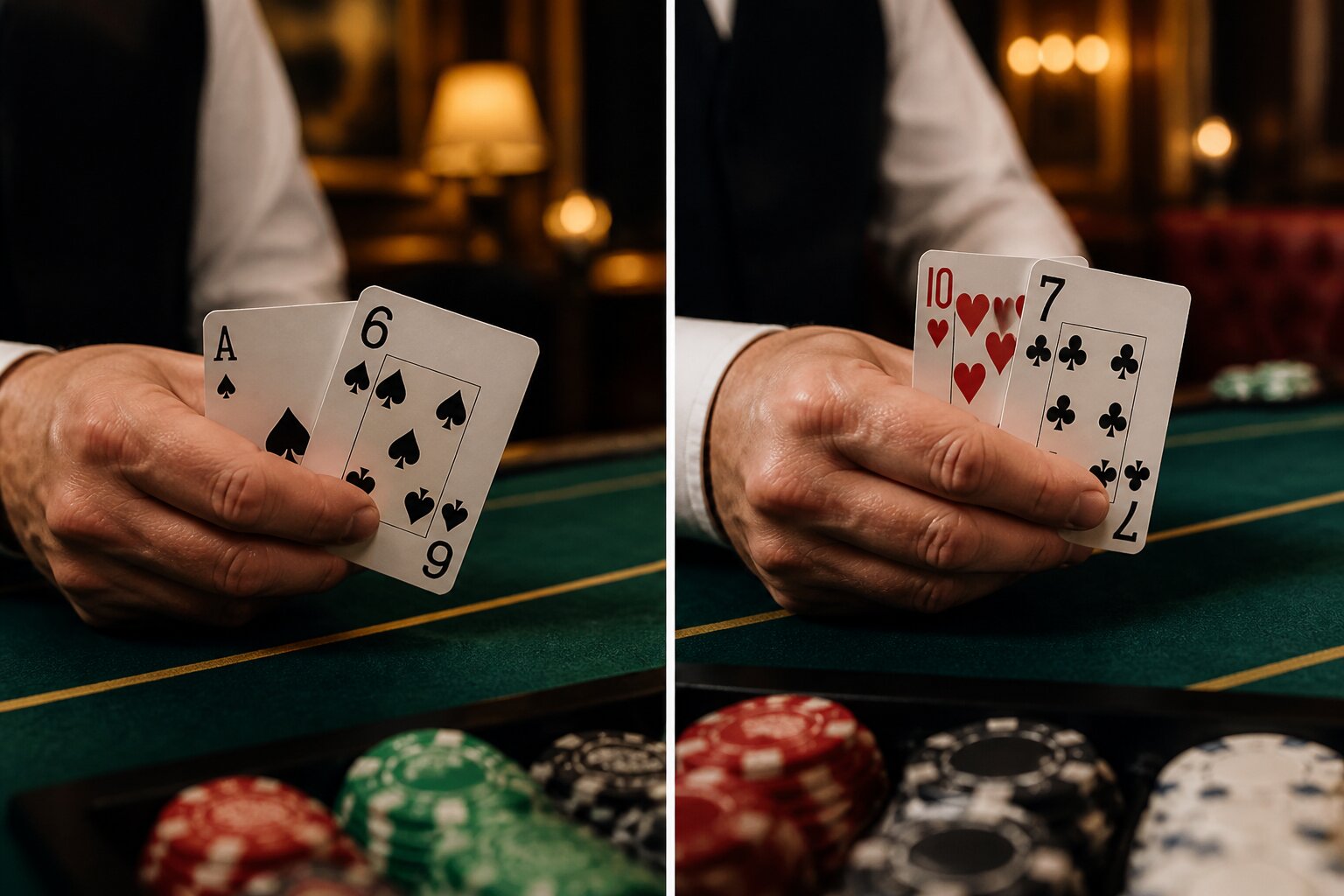
Ever wondered what players mean when they talk about ‘hard’ and ‘soft’ hands in blackjack? If you’ve been puzzled at the table or unsure how to play certain cards, you’re not alone. Understanding the difference between these hands helps you make clearer choices during a round.
Whether you’re new to blackjack or brushing up your knowledge, this guide will explain hard and soft hands and show how they influence the way you play. Read on to learn straightforward tips that can make your decisions at the table easier and more confident.
What Is the Difference Between Hard and Soft Hands in Blackjack?
In blackjack, the terms ‘hard’ and ‘soft’ describe hands based on how an Ace is counted.
A hard hand is any hand that either does not contain an Ace or contains an Ace that must count as 1 because counting it as 11 would put the total over 21. For example, 10 + 7 is a hard 17. If you hold Ace + 9 + 9, the Ace must count as 1, making it a hard 19.
A soft hand contains an Ace being counted as 11 without the total exceeding 21. For example, Ace + 7 is a soft 18. If you draw another card that would push the total over 21 with the Ace as 11, the Ace can instead count as 1, avoiding a bust.
Recognising which type you have is quick once you know the rule about the Ace switching between 1 and 11.
How Do Hard and Soft Hands Affect Your Play?
The hand type changes the margin for error and the range of sensible options.
With a hard hand, there is no flexible Ace to absorb a high card, so the risk of busting is higher when you hit. Decisions with hard totals often aim to balance that bust risk with the need to reach a competitive total.
A soft hand offers more latitude because the Ace can change value if the next card would otherwise bust you. That flexibility can justify taking another card in situations where you would stand with a comparable hard total, and it also affects choices about doubling down when permitted.
Knowing whether your hand is hard or soft helps you weigh potential gains against the risk of ending the round with a losing total.
Common Examples of Hard and Soft Hands
Below are simple examples to help you spot hard and soft hands at a glance.
Examples of hard hands
These are hands with no usable Ace or with an Ace that must be counted as 1. A hard hand cannot change its total by switching an Ace between 1 and 11 because either there is no Ace, or using 11 would make the hand bust.
- 10 + 7 = Hard 17
- 9 + 6 + 2 = Hard 17
- Ace + 6 + 10 = Hard 17 (Ace counts as 1 here)
- 7 + 8 = Hard 15
Examples of soft hands
Soft hands include an Ace that can count as 11 without the total exceeding 21. The main advantage of a soft hand is flexibility: if you take another card and would otherwise bust, the Ace can be revalued as 1 to keep you in play.
- Ace + 7 = Soft 18
- Ace + 5 = Soft 16
- Ace + 3 + 2 = Soft 16 (Ace counts as 11)
- Ace + 2 + 4 = Soft 17 (Ace counts as 11)
These examples reflect everyday situations at the table and should make it easier to identify which category your hand falls into. Remember that a soft total can change into a hard total if you take a card that forces the Ace to be counted as 1.
Why Is the Distinction Important at the Blackjack Table?
Knowing whether a hand is hard or soft influences how you interpret other factors at the table, such as the dealer’s upcard and the house rules.
Recognising your hand type helps you apply standard guidance more accurately. It reduces common errors, like unnecessarily risking a bust with a hard total or missing opportunities to improve a soft total safely. This clarity leads to calmer, better-informed decisions during play.
If you want to refine your approach further, pay attention to how the dealer’s visible card changes the expected value of hitting, standing or using options allowed by the table rules.
Can You Double or Split With Hard and Soft Hands?
Doubling and splitting are tools that can change the course of a hand, and their use is shaped by the cards you hold and the house rules.
Doubling increases your stake in exchange for exactly one additional card. With soft hands, players often find chances to double on soft 16, 17 or 18 when the dealer shows a weaker card; with hard hands, doubling is commonly considered on totals like hard 9, 10 or 11. The precise situations where doubling is advisable depend on the dealer’s card and the specific rules at the table.
Splitting applies when your first two cards are a pair. Splitting Aces is a special case: each Ace usually receives only one extra card, but splitting turns one hand into two distinct ones and can convert a difficult hand into two potentially stronger positions.
Always check the table’s rules before you play, since allowances for doubling after splitting or limiting how many times you may split vary between venues. Increasing your bet via doubling or splitting changes the exposure of your bankroll, so consider whether the potential benefit fits your comfort level.
Myths About Hard and Soft Hands in Blackjack
A few persistent misunderstandings can lead players astray, so it helps to separate fact from fiction.
One myth says soft hands always put you at an advantage. A soft hand offers more options, but it does not guarantee a better outcome. The result still depends on the cards that follow and the choices you make.
Another misconception is that soft hands should always be played aggressively. While flexibility can justify more assertive moves in certain situations, indiscriminate aggression can backfire when a dealer’s card or the table rules don’t support it.
It’s also incorrect to assume hard hands must always be played extremely cautiously. Sometimes a calculated hit or double with a hard total is the sensible option, depending on context.
Clear thinking and an awareness of the true probabilities behind common plays will serve you better than relying on rules of thumb or myths.
Summary: Key Takeaways on Hard vs Soft Hands
Understanding the difference between hard and soft hands gives you a practical edge in making decisions during a game of blackjack.
Main points to remember
Hard hands don’t allow the Ace to act as 11, so they have less flexibility.
Soft hands include an Ace counted as 11, providing a safety valve if you draw a high card.
Which hand you hold affects the viability of hits, stands and when doubling makes sense.
Splitting depends on pairs and can change the nature of your choices.
Avoid following myths; assess each hand against the dealer’s upcard and the table’s rules.
Finally, play within limits and treat gambling as paid-for entertainment. If you ever feel uncertain about your play or that gambling may be causing harm, help is available. Enjoy the game responsibly and keep your decisions deliberate and informed.
**The information provided in this blog is intended for educational purposes and should not be construed as betting advice or a guarantee of success. Always gamble responsibly.