
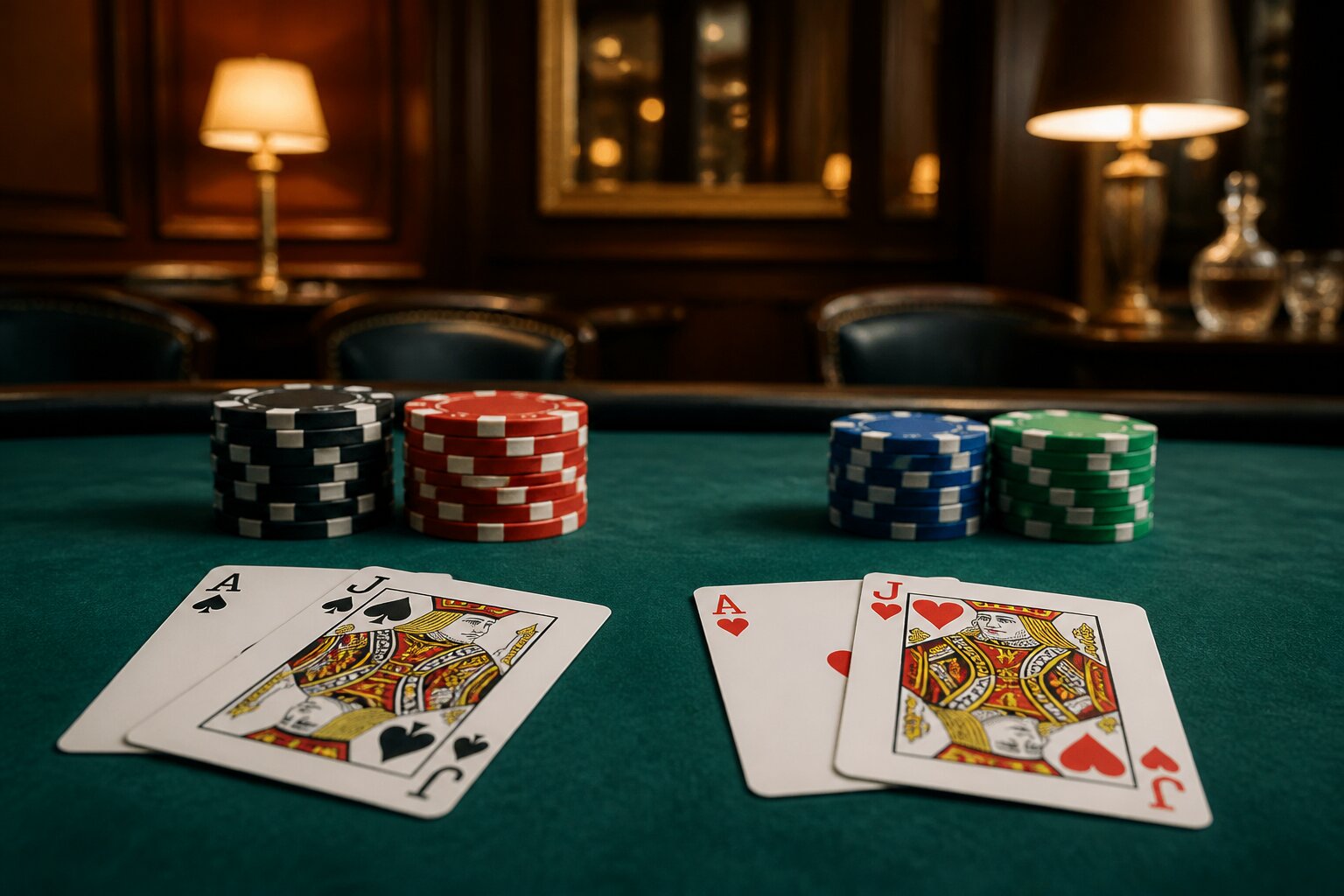
Ever wondered if blackjack and pontoon are just different names for the same card game? You’re not alone — the two share a family resemblance, but their rules and terms diverge in ways that change how each game plays.
Before you pull up a chair at a table or play online, it helps to know what distinguishes them. This guide explains the rules, key hands, and practical differences so you can decide which game suits you best. If you’re 18 or over, read on to get a clear picture of what to expect at each table.
What Is Blackjack?
Blackjack is one of the most recognisable casino card games. The basic aim is to form a hand valued as close to 21 as possible without going over, and to finish with a higher total than the dealer. Each player receives two cards and the dealer receives two — typically one face up and one face down. Number cards count at face value, face cards count as 10, and aces can be 1 or 11 depending on which value benefits the hand.
Players choose whether to take another card or keep their current total; there are also options such as doubling down or splitting pairs where permitted. A hand composed of an ace and a ten-point card is the best regular outcome and receives a higher payout than a standard win in most games.
Blackjack’s straightforward objective and clear choices give it wide appeal — whether in a casino or online. If you prefer a game where some dealer information is visible and decisions are influenced by that knowledge, blackjack offers that clarity. This contrast in information is part of what separates it from pontoon, which we’ll explore next.
What Is Pontoon?
Pontoon is a British variant of the twenty-one family with its own terminology and a few rule changes that change how rounds play out. The goal remains to reach 21 or as close as possible without exceeding it, but the dealer’s hand is handled differently: both dealer cards are dealt face down. That concealment makes player choices more tentative, because there is no visible dealer card to guide decisions.
A two-card ace plus ten-point card is called a pontoon and outranks other 21s. Pontoon also values a five card trick — holding five cards without going over 21 — as a strong winning hand. The customary verbal terms differ too: players ask to “twist” for another card and “stick” to keep their hand. Some versions force players to twist on low totals (commonly 14 or under), which alters risk and reward compared with blackjack.
These rule differences shift how rounds feel and how aggressive or cautious a strategy might be. With that in mind, the next section compares the rules side by side so you can see precisely how each game shapes decisions.
How Do the Rules Differ?
Although both games share the twenty-one objective, a few specific rules change the balance of each game. Card values remain the same across both: numeric cards at face value, face cards at 10, and aces flexible as 1 or 11. Where they diverge is in how the dealer’s cards are presented, mandatory actions, special hands, and typical payouts.
In blackjack the dealer usually shows one card and keeps one hidden, which allows players to make choices with partial visibility. Pontoon’s fully face-down dealer hand removes that visibility, increasing uncertainty when deciding to take more cards. Some pontoon variants require players to take another card on low totals, whereas blackjack usually leaves that choice to the player. Splitting and doubling are available in both but are controlled by house rules that vary by venue.
Special hands also differ. Blackjack’s two-card 21 is a high-priority result, while in pontoon the pontoon specifically outranks all other hands and the five card trick carries its own value. Payouts tend to reflect these differences: blackjack traditionally offers 3:2 for a two-card 21, while pontoon sometimes pays differently for pontoons or five card tricks. Always check the table rules where you play to know the exact payouts and permitted actions.
Having covered the rule contrasts, the next section looks at how these differences influence each game’s popularity in the UK.
Which Game Is More Popular in the UK?
Blackjack is the more commonly encountered game across casinos and online platforms in the UK. Its familiar rules, visible dealer card, and a wide range of variants make it a standard offering at most sites and venues. Pontoon survives as a recognised British variant but appears less frequently, often found in specific tables or informal games rather than as a mainstream casino staple.
This difference in presence doesn’t mean one game is inherently better; it means they occupy different roles. Blackjack’s ubiquity makes it easier to find tables and practice variants, while pontoon appeals to players who like the added concealment and special hands it offers. If you’re deciding what to try, availability may steer your choice, but personal taste in game flow should matter most.
Common Myths About Blackjack and Pontoon
Several persistent misconceptions can affect how newcomers approach these games. One is the notion that memorising simple patterns or systems will consistently beat the house. In truth, understanding the rules and odds helps make better decisions, but no routine can change the underlying probabilities set by the game rules and payouts.
Another frequent belief is that previous rounds influence the next; in both blackjack and pontoon each round is independent, and past outcomes do not alter the mathematical chances of future results. Practices like card counting are also widely misunderstood: modern play often uses multiple shuffled decks and frequent shuffling, which greatly reduces the practicality and effectiveness of such methods.
Knowing what is and isn’t realistic sets appropriate expectations and supports more measured choices at the table.
Should You Choose Blackjack or Pontoon?
Your choice comes down to the experience you prefer. If seeing one of the dealer’s cards and making informed choices appeals, blackjack’s visibility and range of strategic options may be the better fit. If you enjoy not knowing the dealer’s total and value special outcomes such as a pontoon or five card trick, pontoon provides a distinct challenge.
Think about the pace you like and how much uncertainty you want to manage. Also consider table rules and payouts at the venue you plan to use, since small rule changes can shift which game gives better value for certain plays. Above all, set clear limits on play and spend to keep the experience enjoyable and controlled.
Whether you choose blackjack or pontoon, both offer engaging ways to test decision-making under clear rules; pick the one that feels more fun to you and suits the style of play you prefer.
**The information provided in this blog is intended for educational purposes and should not be construed as betting advice or a guarantee of success. Always gamble responsibly.