
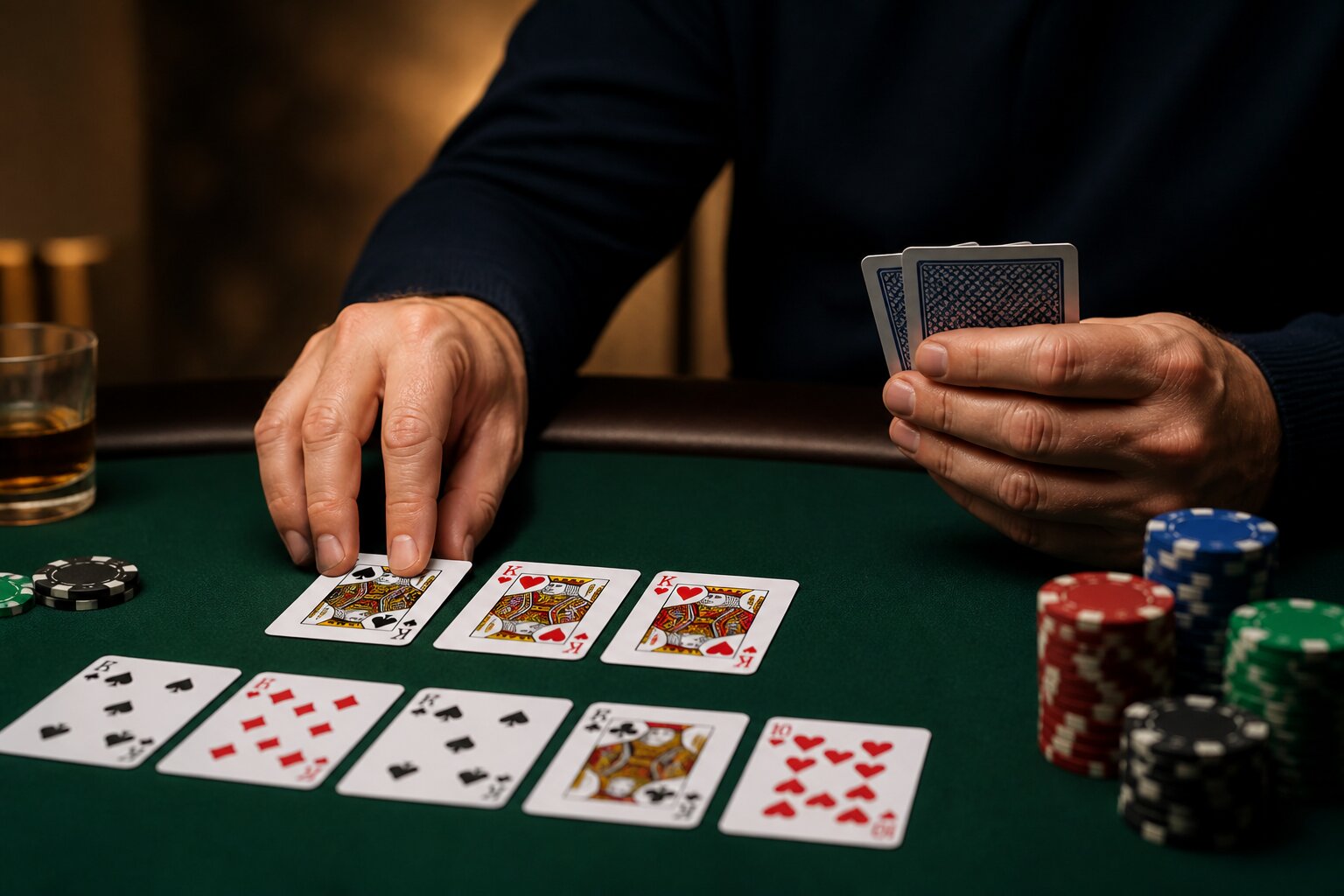
Ever been at the poker table and heard players talk about "hitting a set"? If you’re new to the game, or just want to brush up on poker terms, this guide will make the difference clear.
Knowing how a set differs from other three-of-a-kind hands affects how you read the table and size your bets. Read on to see exact definitions, practical examples and how sets change the way a hand plays out.
What Does the Term ‘Set’ Mean in Poker?
A set in poker is three of a kind made with a pocket pair and one matching community card. In Texas Hold’em, for instance, if you hold two 7s and a 7 appears among the community cards, you have a set of 7s.
What makes a set distinct is that it uses both cards in your hand plus one on the board. That composition often keeps the hand obscured from opponents, since someone watching only the table cards will not immediately see you have a pocket pair.
This kind of concealment is why players talk about sets with interest: they can win large pots when opponents misread the strength of the holdings.
How Is a Set Made in Poker?
Forming a set happens when your initial pair connects with a matching card on the board. Hold a pair of 9s, and when a 9 comes on the flop, turn or river, you have a set of 9s.
Because the third card can appear at different stages, a set can materialise early on the flop or later as more community cards arrive. The timing affects how the hand should be played: a set that appears on the flop gives you more information to press for value, while one that comes on the turn or river may require a more cautious approach depending on the board texture.
Sets are not common every hand, so when you do make one it often changes the dynamic of the betting and how opponents respond.
Set vs Trips: What Is the Difference?
Both sets and trips are three of a kind, but the difference lies in where the cards come from. A set uses two cards from your hand plus one on the board. Trips are formed with one card in your hand and two matching community cards.
This difference matters for how visible the hand is. Trips are easier for opponents to spot since two of the matching cards are on the board, making it more likely others will realise that three of a kind is possible. With a set, opponents may not suspect you have a pocket pair and can therefore misjudge the strength of your holding.
Understanding this distinction helps you choose how aggressively to play and when to disguise the strength of your hand.
Why Are Sets So Valuable in Poker?
Sets are valuable because they combine strong showdown potential with concealment. When you hold a set, you often have the best three-card combination at the table, and because your pair started in your hand, opponents are less likely to read your strength from the board alone.
That said, a set is not invulnerable. Community cards can produce straights and flushes, or a higher set can appear. The relative value of your set depends on the board texture and how many players are in the pot. With fewer opponents a set is more likely to hold; in multi-way pots with coordinated boards, caution can be necessary.
Being aware of these factors helps you extract value without exposing yourself to unnecessary risk.
Common Misconceptions About Sets and Trips
One misconception is that sets always beat trips in practical play. While sets are often better concealed, trips can be just as strong depending on the situation and the board. Another is that three of a kind guarantees a big win; in reality, straights, flushes and full houses can overtake both sets and trips.
Players sometimes overestimate how often pocket pairs improve. Recognising how rare certain outcomes are helps with realistic expectations and smarter decision-making at the table.
Examples of Sets in Real Poker Hands
Seeing sets in context makes them easier to identify. Picture being dealt two 5s. The flop arrives and includes another 5. You now hold a set of 5s—two from your hand and one from the board. That hand can be played aggressively if the board is dry, or more cautiously if the community cards create straight or flush possibilities.
Another scenario: you have pocket Queens and the turn brings a Queen, completing your set. How you respond will depend on how the betting has unfolded and whether the board gives opponents obvious draws.
A later river card can also complete a set. If a third card matches your pocket pair on the river, you may have only one betting street left to extract value, which changes how you size bets and which lines you choose.
These examples show how timing and board texture shape the route from making a set to turning it into value.
How Do Sets Affect Poker Odds and Outcomes?
Hitting a set changes the odds in a hand by improving your relative hand strength, but it does not guarantee success. The rarity of sets means they can be potent, especially when opponents do not suspect them, yet evolving community cards can still produce superior hands.
When a set appears on the flop you have more room to manoeuvre; when it comes on the turn or river, you must weigh the limited opportunities for value against potential threats that have already shown themselves. The way opponents have been betting also provides clues about whether your set is likely to hold.
Appreciating how sets interact with the board and player behaviour leads to more effective play and better pot decisions.
Summary: Understanding Sets in Poker
A set is three of a kind formed from a pocket pair and one community card. Its concealment often makes it a powerful hand, but board texture and other players’ holdings remain important. Knowing how sets differ from trips, recognising common misunderstandings, and examining real examples will sharpen your reading of the table and your betting choices.
If you need support with gambling-related issues, help is available from national resources. Play responsibly and keep your play within personal limits.
**The information provided in this blog is intended for educational purposes and should not be construed as betting advice or a guarantee of success. Always gamble responsibly.