
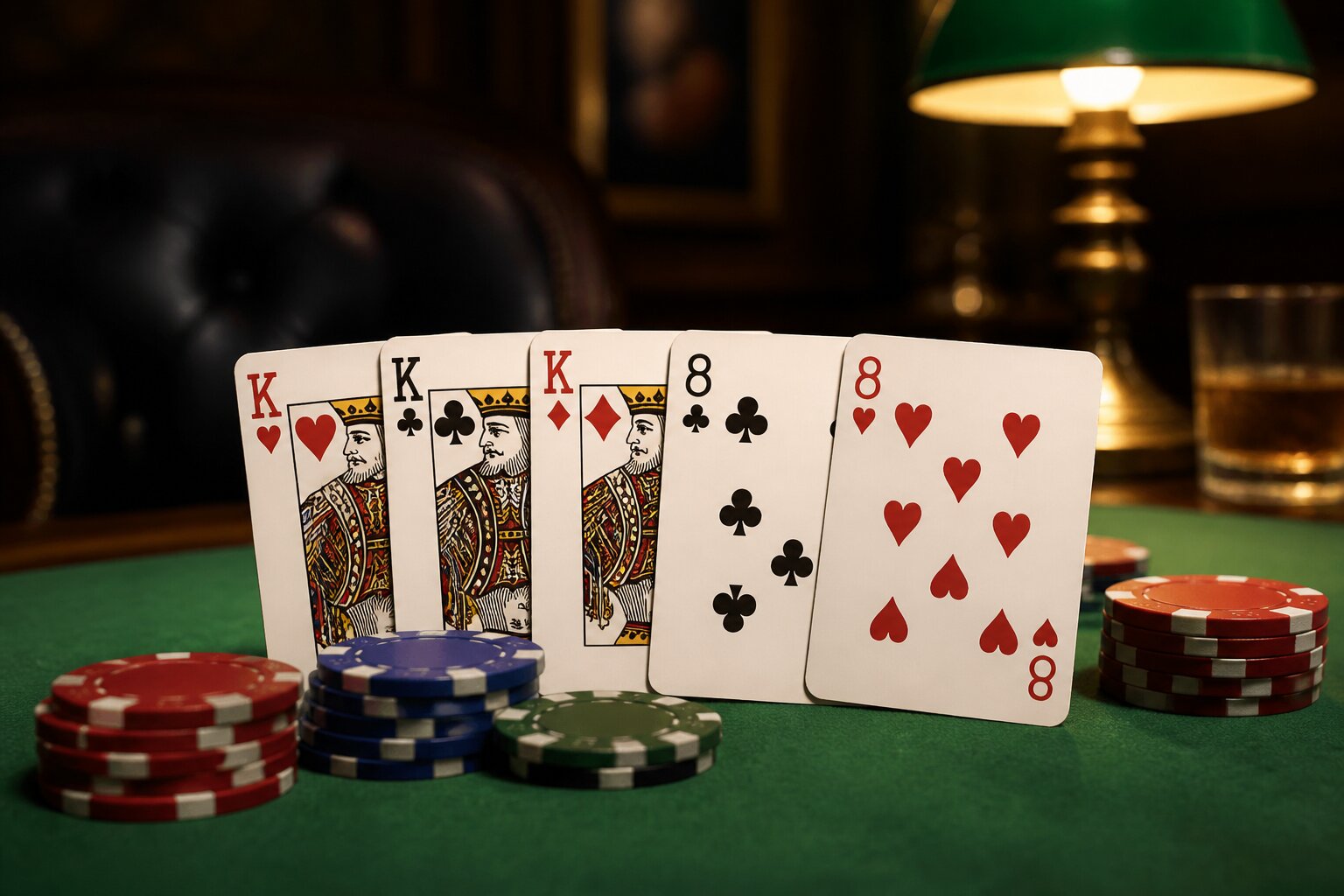
Ever wondered why players celebrate a “full house” at the poker table? If terms like “three of a kind” or “pair” leave you scratching your head, you’re not alone.
Knowing the hand rankings makes the game clearer and more enjoyable, whether you’re just starting out or brushing up before a game. This article explains what a full house is, how it compares with other hands, and shows clear examples so you recognise one at a glance.
Curious to see how a full house is named and ranked? Let’s get into it.
What Does a Full House Consist Of in Poker?
A full house is a five-card hand that combines three cards of the same rank with two cards of another matching rank. In plain terms, you need both “three of a kind” and “a pair” together in the same hand.
For example, three 8s plus two 4s is called “Eights full of Fours”:
8♠️ 8♥️ 8♦️ 4♠️ 4♣️
Another is three Kings and two Aces:
K♠️ K♥️ K♣️ A♦️ A♣️
Hands are compared first by the rank of the three matching cards, then by the rank of the pair. So three Kings with a pair of Aces beats three Queens with a pair of 10s. This ranking rule is important when more than one player holds a full house in the same round.
How Is a Full House Ranked Among Poker Hands?
A full house ranks high among poker hands, beating many common hands but falling short of a few rarer combinations. From top to bottom, the highest hands are:
Royal Flush
Straight Flush
Four of a Kind
Full House
Flush
Straight
Three of a Kind
Two Pairs
One Pair
High Card
This order determines which hand wins at showdown. Because the three-of-a-kind component carries more weight than the pair, a full house with a higher three wins over one with a lower three. Keep this in mind when comparing hands on the table.
Before moving on to examples, note that outcomes depend on the cards dealt and probabilities involved; nothing is guaranteed in a single round. Play within your limits and be mindful of responsible play.
Full House Examples: Understanding the Combinations
Here are clear examples to help you spot full houses in practice. Each name uses the three matching cards first, then the pair.
-
Example 1 – "Queens full of Sevens"
Q♦️ Q♥️ Q♠️ 7♣️ 7♦️ -
Example 2 – "Fours full of Kings"
4♣️ 4♠️ 4♦️ K♥️ K♠️ -
Example 3 – "Tens full of Sixes"
10♠️ 10♣️ 10♦️ 6♥️ 6♦️
The way names are formed makes it easier to call the hand and compare it with opponents’ holdings during play.
When comparing two full houses, the three-of-a-kind part decides which hand is stronger. If both hands have the same three-of-a-kind, the pair is used to break the tie. Suits have no effect on the ranking of full houses.
Can a Full House Be Beaten?
Yes. Several higher-ranking hands can beat a full house:
- Four of a Kind (four cards of the same rank, for example, four 5s)
- Straight Flush (five consecutive cards of the same suit, such as 5-6-7-8-9 all hearts)
- Royal Flush (the highest straight flush, 10-J-Q-K-A of one suit)
If multiple players hold full houses, the one with the higher three-of-a-kind wins; if those are equal, the higher pair breaks the tie. Understanding these comparisons helps you evaluate the strength of your full house in relation to the board and other players’ possible holdings.
Knowing which hands beat a full house also informs how you interpret the betting and whether to stay in a pot.
Common Misconceptions About Full Houses in Poker
A few misunderstandings tend to circulate among players:
- A full house is not an automatic win. Strong as it is, other hands can still beat it.
- Not all full houses are equal; the ranks of the three-of-a-kind and the pair determine which full house is superior.
- There’s no method or ritual that changes the card probabilities; outcomes follow the distribution and rules of the game.
If you keep these points in mind, you’ll make clearer judgements about betting and folding. Also, set sensible limits and be aware of your playing habits to keep the experience positive and controlled.
Why Is a Full House Important in Poker Games?
The full house adds strategic depth to poker. Because it sits above flushes and straights but below four of a kind, it creates interesting decision points:
- assessing whether your full house is the best possible hand given the board
- deciding how aggressively to bet or whether to slow-play
- reading opponents' betting patterns to judge the likelihood they have a stronger combination
Players must weigh the strength of their hand against the community cards and the betting behaviour of others. That process often involves checking what potential hands the board allows, how many cards could improve opponents' holdings, and whether the pot odds justify continued investment.
It also influences how players read the table. A full house can justify bolder betting in some situations but calls for caution in others, especially when the community cards allow possible four-of-a-kinds or straight flushes. Factors that typically change the approach include the number of opponents in the hand, the size of the pot, and the betting history across the round.
In short, the full house contributes to the tension and strategy that make poker engaging. It rewards careful consideration, experience in hand reading, and disciplined betting decisions, all of which help separate more skilful players from casual ones.
Full House vs Other Strong Poker Hands
Understanding how a full house stacks up against other strong hands clarifies those tense moments at showdown.
Full House vs Four of a Kind
A four of a kind always beats a full house. For example, four 7s will outrank any full house regardless of its composition.
Full House vs Flush
A full house beats a flush. So five cards of the same suit lose to a hand that contains three of a kind plus a pair.
Full House vs Straight
A full house also wins over a straight, since a straight is five connected ranks without regard to suits.
Full House vs Three of a Kind & Pairs
Full houses are well above three of a kind, two pairs, one pair, and a high card, making them among the more powerful hands you’ll hold.
Knowing these relationships helps you judge whether to continue in a hand when you suspect an opponent may hold one of the stronger combinations.
Thanks for reading—if you want to see probability figures or examples from specific variants like Texas Hold’em or Omaha, I can add a focused section on that next.
**The information provided in this blog is intended for educational purposes and should not be construed as betting advice or a guarantee of success. Always gamble responsibly.