
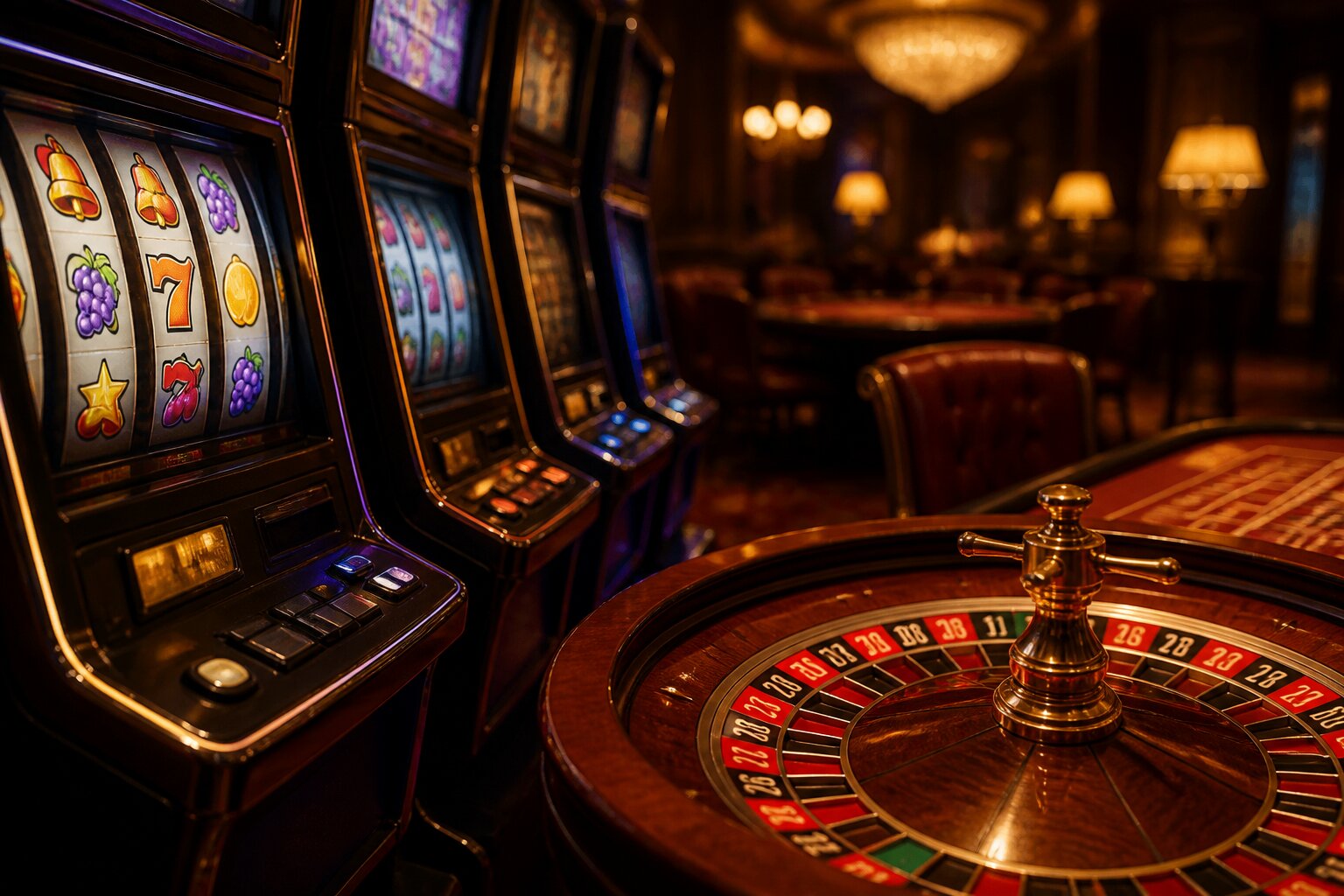
Looking to enjoy a flutter at the casino but not sure whether to spin the slots or place your chips on the roulette table? You’re not alone. Picking between these two popular options comes down to how you like to play and what you expect from the experience.
This article breaks down how each game works, what to expect from payouts and house edge, and which style of play might suit you best. Read on to discover the differences and decide which game fits your tastes.
How Do Slot Machines Work?
Slot machines are among the simplest games in a casino. You choose a stake, start a spin, and watch the reels. Modern slots use a Random Number Generator (RNG) so every spin is independent; previous results do not affect future outcomes.
Most slots offer multiple paylines across the reels. Matching symbols on an active payline produce a payout according to the game’s paytable. You often have choices such as how many paylines to activate and whether to use features like free spins or bonus rounds. These choices change bet size and the pattern of possible wins, but they do not alter the underlying odds set by the game’s RTP.
RTP, or Return to Player, is the long-term average percentage of stakes returned to players. A slot with a 96% RTP implies that, over many plays and players, roughly 96% of the money wagered is returned in winnings. That statistical measure is useful when comparing games, but it does not predict any individual session. Keep your budget in mind before you play and treat slots as entertainment.
How Does Roulette Work?
Roulette centres on a spinning wheel and a betting layout. Players place chips on numbers, colours, or groups of numbers; the dealer then spins the wheel and releases a small ball that eventually settles in a numbered pocket. If the ball lands on a spot you backed, you receive a payout based on that bet’s odds.
Bets vary from single numbers, which pay more, to even-money propositions such as red or black, which pay less but cover more outcomes. European roulette features a single zero, affecting the house edge, while some other variants include additional zeros that change the odds. Like slots, every spin is independent; the result is not influenced by earlier spins.
Roulette’s range of bet types makes it appealing for players who enjoy different risk profiles within one game: higher-risk, higher-reward single-number bets alongside lower-risk bets that offer steadier returns.
What Are the Key Differences Between Slot Machines and Roulette?
The most visible differences are how you interact with the game and the tempo of play.
Slots are usually solitary and fast. You control when a spin starts and can play at your own speed with little waiting. The design is focused on themes, audiovisual effects, and in-game features that create variety across sessions.
Roulette is more structured around rounds of betting. There is a natural pause while bets are placed and results revealed, which can feel more communal in a live setting. The decision-making in roulette revolves around selecting from a set of defined bet types with known payouts, whereas slots centre on choosing stakes and activating features within the game’s structure.
Both offer distinct experiences, so consider whether you prefer continuous individual play or a rhythm that includes short pauses between rounds.
Payouts: Which Game Offers Better Odds?
Payouts depend on the game and the bets you make.
Slots rely on RTP and the specific paytable of each title. RTP values typically range from the mid-90s upward; comparing RTPs helps you choose games that statistically return more over the long term, though it says little about short sessions.
Roulette uses fixed odds for each bet type. Single-number bets pay 35 to 1, while even-money bets come close to a 50/50 split, excluding the zero pocket. European roulette carries a house edge of around 2.7% because of the single zero. These fixed relationships make it clear what each bet offers in return.
Neither game guarantees wins. Use RTP and known roulette payouts as tools to set expectations and choose games that fit the balance between risk and reward you prefer.
House Edge: What Should You Know?
The house edge is the mathematical advantage the casino holds over players across all games.
In roulette, the number of zero pockets determines this edge. European roulette’s single zero yields an edge of about 2.7%. Versions with additional zeros raise the edge, reducing expected returns for players.
For slots, the house edge is the inverse of RTP. A slot with a 96% RTP effectively carries a 4% house edge. That figure varies by title, so selecting higher-RTP slots can marginally improve long-term returns.
Understanding house edge helps you compare games and pick options that match your tolerance for risk. It also clarifies that short-term outcomes are unpredictable, while the house advantage plays out over many rounds.
Is One Game More Social Than the Other?
Social atmosphere differs between the two games.
Slots are typically solitary experiences, whether played on a machine or a screen. They suit players who prefer to focus on game features and personal pacing. Roulette often feels more social, particularly in live dealer environments, where players and a dealer share the same round and reactions are communal.
If interaction is part of your enjoyment, roulette offers opportunities to play alongside others and follow the same spin. If you prefer to play quietly and at your own pace, slots provide that privacy. Either way, keep your focus on playing within set limits.
Common Myths About Slot Machines and Roulette
Several persistent myths can mislead players.
One frequent misconception is that a slot machine is “due” to pay after a long losing run. Because slots use random number generators (RNGs), each spin is independent. Previous results do not change current odds, so there is no scientific basis for thinking a machine will suddenly become more likely to pay out.
Similarly, beliefs about roulette “hot” and “cold” numbers ignore the independence of spins. Each spin is a separate event and past outcomes do not influence future ones. Thinking a number is more likely because it has not come up recently is a fallacy.
Another common misunderstanding is that particular machines or tables can be beaten by following patterns or betting strategies. No betting system or pattern can overcome the mathematical house edge in the long run. Over many plays, the expected returns will align with the stated return to player figures and the fixed payouts in roulette.
To make better decisions, rely on accurate information and clear facts, such as:
- RTP figures for slots, which show the theoretical percentage returned to players over time.
- Fixed payouts for roulette, which determine the true odds and house edge for each bet.
- The independence of individual spins and the role of RNGs in slots.
Using this information helps you make informed choices rather than following myths or unfounded strategies. Always play responsibly and within your limits.
Choosing the Right Game for Your Preferences
Deciding which game suits you depends largely on the experience you want. Think about pace, interaction, and what entertains you most rather than potential winnings.
Pace and Style
If you enjoy uninterrupted, solo play with rapid rounds and in-game variety, slots are likely a good fit. If you prefer a measured rhythm, the shared moment of a spinning wheel, and a clear set of betting options, roulette could be more satisfying.
Entertainment Value
Consider what keeps you engaged: themed visuals, bonus features and sound design in slots, or the tactile simplicity and suspense of roulette’s wheel and layout. Choose the environment that feels enjoyable and sustainable for the time you plan to spend playing.
Playing Safely
Set time and spending limits before you play and make use of any available account tools to help stick to them. If gambling stops being enjoyable or starts to affect other parts of life, seek support through recognised help services and consider self-exclusion options. Playing within personal limits preserves the entertainment value of both games.
Whichever game you try, treat it as a form of entertainment and make choices that match your preferences and boundaries. Enjoy the experience and play responsibly.
**The information provided in this blog is intended for educational purposes and should not be construed as betting advice or a guarantee of success. Always gamble responsibly.