
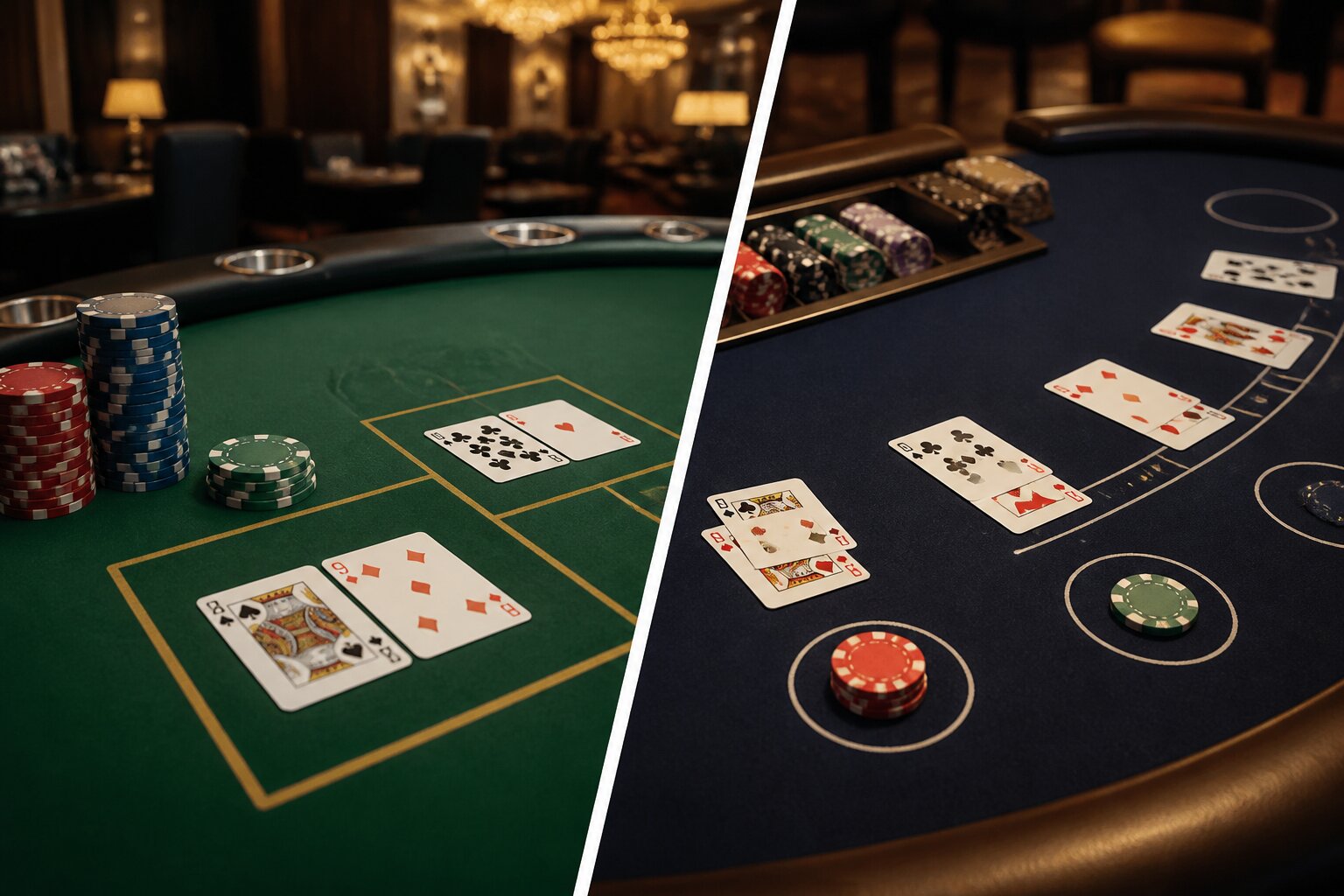
Are you torn between playing baccarat or blackjack at the casino? Both games are popular and offer distinct styles of play that suit different moods and preferences.
Whether you want a simple betting experience or a game that rewards informed decisions, understanding the rules, odds and table flow will help you pick the right option. Read on to compare the two classics and decide which fits your style.
What Are the Basic Rules of Baccarat?
Baccarat is played between two hands, labelled ‘Player’ and ‘Banker’. As a punter you place a wager on which hand you think will finish nearest to a total of 9, or whether the round will end in a tie.
Each hand starts with two cards. Cards from 2 to 9 count at face value, tens and picture cards count as zero, and aces count as one. When totals exceed 9, only the second digit is used; for example, a total of 15 counts as 5. A third card may be dealt according to a fixed set of rules that apply automatically, so there are no choices to make once betting closes. The higher qualifying total wins and pays according to the bet you placed.
Because decisions during the round are pre-determined, baccarat is primarily about choosing which bet to back and managing your stake. Understanding the card values and how the third-card rules work helps clarify why different bets carry different odds.
What Are the Basic Rules of Blackjack?
Blackjack is played against the dealer rather than against other players. The aim is to have a hand value as close to 21 as possible without exceeding it.
Both player and dealer receive two cards at the start. Number cards carry their face value, face cards count as ten and aces can count as either one or eleven, depending on which value benefits the hand. Players then decide whether to take another card (hit) or to keep their current total (stand). Other plays such as doubling down or splitting pairs are allowed in many casinos, subject to the house rules. If a player’s total exceeds 21, that hand is lost. After all players have acted, the dealer plays according to prescribed rules, typically standing on a set minimum such as 17.
Blackjack requires more tactical decisions during each round. Learning how different choices affect the house edge and your potential returns is key to playing effectively.
How Do the Table Layouts Differ?
Table design and seating reflect how the games are played. Baccarat tables are usually larger and can accommodate many players, with clearly marked areas for betting on the Player, Banker or Tie. A dealer controls the pace of the game from the centre, handling the shoe and resolving bets.
Blackjack tables are generally smaller, seating fewer players. Each punter has an individual betting area in front of them, and play proceeds around the table with each player resolving their own hand against the dealer’s. The compact layout emphasises the player-versus-dealer dynamic and supports decisions such as hitting or standing.
These physical differences mirror the gameplay: baccarat is collective in the sense everyone stakes on the same two hands, whereas blackjack centres on individual choices and hands.
Which Game Has Better Odds?
Knowing the house edge is important when comparing the two games. The house edge expresses the long-term advantage the casino holds over players, and it varies with the bet or the specific rules in play.
House Edge Explained
In baccarat, the most favourable bet is typically the Banker, which commonly carries a house edge around 1.06%. The Player bet is usually slightly higher, near 1.24%. The Tie bet offers a much higher payout but comes with a substantially larger house edge, making it the less favourable option for most players.
Blackjack’s house edge depends heavily on the table rules (such as how many decks are used and whether the dealer hits on soft 17) and on player decisions. When played with basic strategy, some blackjack rules can reduce the house edge to around 0.5%, while less favourable rules push it toward 2% or more. Good decision-making narrows the gap, but the exact edge depends on the variant and rules at the table.
Comparing the two, both games can offer relatively low house edges if you choose your bets and tables carefully; baccarat’s banker bet is consistently straightforward, while blackjack rewards informed play.
How Is Gameplay Different in Baccarat and Blackjack?
Gameplay differs most in how much control the player has. Baccarat involves placing a bet and watching the cards be dealt according to a fixed process. Once stakes are placed, there are no further choices during that round, which makes the experience quick and predictable in structure.
Blackjack is interactive. Each decision — whether to take another card, stand, double down or split — alters the possible outcomes for that hand. Players who enjoy weighing risk and reward and adapting to their cards will find blackjack more engaging, while those who prefer a simpler rhythm often favour baccarat.
The difference in involvement also shapes social dynamics: baccarat feels more like an audience watching two hands resolve, while blackjack places each player at the heart of their own contest with the dealer.
Which Game Pays Out More?
Payouts depend on the bet or the specific result. In baccarat, winning Player or Banker bets are normally paid at evens (1:1). Banker wins are often subject to a commission, commonly around 5%, which reduces the net payout slightly. Tie bets offer larger nominal payouts, often 8:1 or 9:1, but given their poorer odds they are less attractive to most players.
In blackjack, a winning hand usually pays 1:1. A natural blackjack — an ace and a ten-value card on the initial deal — commonly pays 3:2, which is a stronger return and part of why blackjack remains popular. Pushes, where player and dealer totals match, return the original stake.
So payouts combine both the ratio and the probability of each outcome. Baccarat’s banker bet gives steady returns with a small commission, while blackjack’s blackjack payout rewards certain initial hands more generously.
Are There Common Myths About Baccarat and Blackjack?
Several misconceptions circulate about these games. One is the idea that previous outcomes can predict future results. Because each round is independently resolved according to the cards dealt, past results do not determine future ones.
Another myth is that there are foolproof systems that guarantee profit. Betting systems can affect short-term variance, but they do not alter the mathematical advantage the house has over time. Finally, beliefs that specific seats or rituals influence the result are not supported by how the games are structured.
Clearing up these misunderstandings helps set realistic expectations and encourages a more thoughtful approach to playing.
Knowing the differences in involvement and edge naturally leads to the question of suitability.
Which Game Is Best for Beginners?
Beginners should choose according to how much decision-making they want. Baccarat’s simple betting structure is easy to grasp: place a bet, watch the cards and accept the outcome. That makes it straightforward for someone who prefers minimal in-round choices.
Blackjack introduces more to learn, from hand values and terminology to the impact of choices like doubling and splitting. For players who enjoy learning and applying basic strategy, blackjack offers rewarding depth; for those who prefer a simpler, less interactive experience, baccarat may be a better fit.
Either way, approaching the games with clear limits and an understanding of the rules makes the first sessions more enjoyable and less stressful.
How to Choose Between Baccarat and Blackjack
Choosing between the two comes down to the style of play you prefer and how much engagement you want during each round.
If you favour a hands-off experience with simple wager options, baccarat provides a steady, predictable flow. If you want to influence the course of individual rounds and apply strategy, blackjack offers more opportunities to do so. Consider also the table rules and payouts where you play, because those details affect both enjoyment and value.
Whichever you prefer, set a budget before you sit down and keep to it. That helps ensure the session stays enjoyable and under control. If you’d like to try either game here at our site, you’ll find tables that suit both tastes, along with clear rules so you can play with confidence.
**The information provided in this blog is intended for educational purposes and should not be construed as betting advice or a guarantee of success. Always gamble responsibly.