
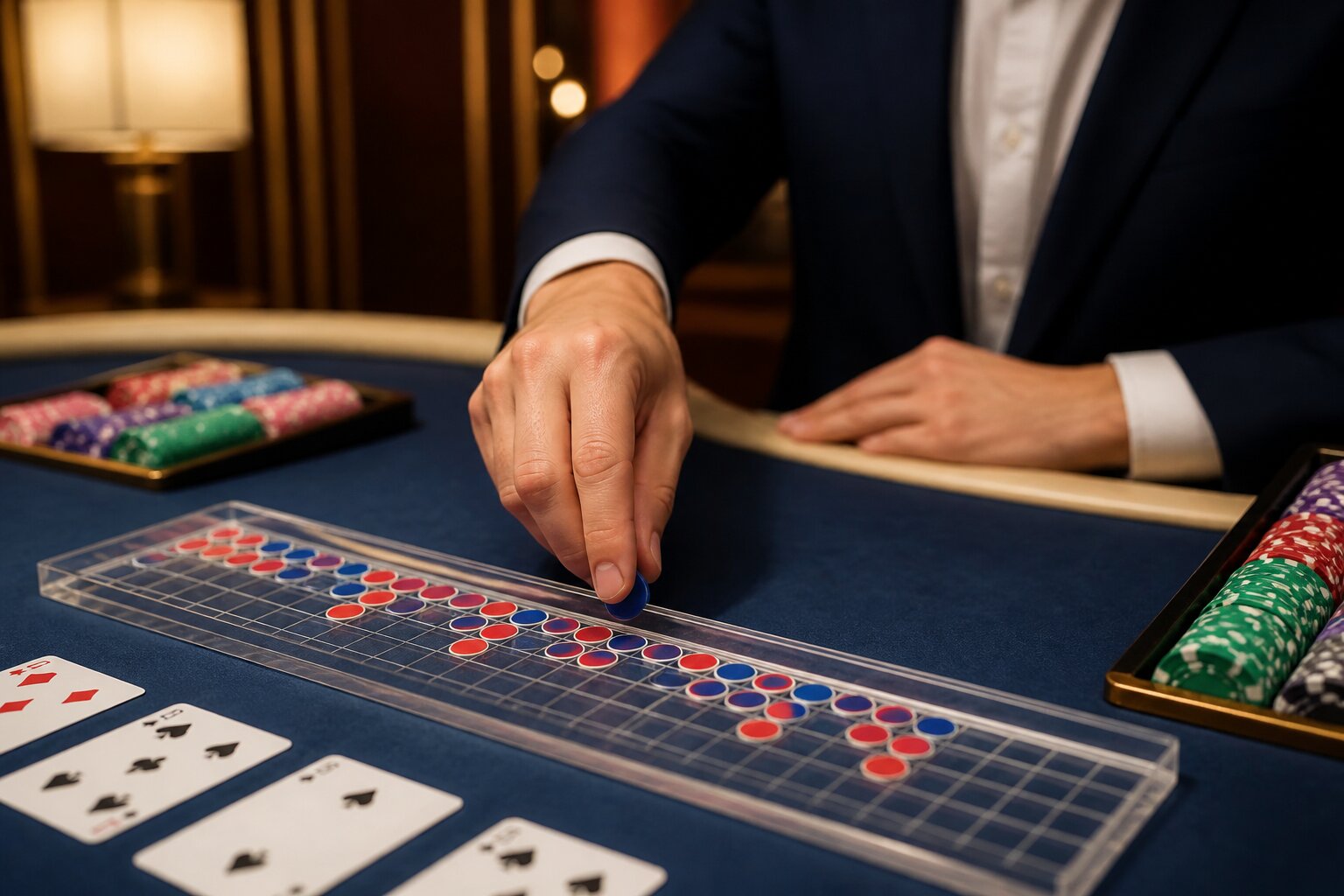
Ever noticed people at the baccarat table scribbling in little notebooks or watching rows of results intently? It can look as if they’re tracing a secret code that tells them what will happen next. With so many claims about “baccarat patterns” and hidden strategies, it’s natural to wonder whether anyone really has an edge.
Many swear by streaks or sequences they believe predict the next result, and that belief keeps the search for patterns alive in both live and online play. This article examines where those claims come from, what they mean in practice, and whether they actually change the game’s mathematics.
Read on to see what the evidence shows and to view a simple example that illustrates why pattern strategies are more ritual than advantage.
What Are Baccarat Patterns?
Baccarat patterns are the shapes and sequences players look for in the outcome history of each round. The game produces only three possible immediate results: Player, Banker or Tie. Because those results are easy to record, players often try to spot runs — several of the same outcome in a row — or alternations that resemble a “chop”.
People mark these sequences on scorecards or use digital overlays to turn raw outcomes into grids and lines. Over time, certain formations on a card can feel meaningful: a long run of Banker wins might look like a “streak”, for example, while an ABAB sequence resembles a consistent alternation. Those visual cues make the game seem more predictable, even though the dealing process uses shuffled standard decks and each hand is statistically independent.
Players’ tracking tools vary in complexity from simple marks to more elaborate charts. Understanding what these tools do is useful before assessing whether they deliver any real predictive power. The next section looks at the evidence behind claims that such pattern strategies can influence outcomes.
Do Secret Baccarat Pattern Strategies Really Work?
Short answer: no credible evidence shows pattern systems alter the underlying odds. Baccarat’s probabilities are fixed by the rules and the number of decks used. For instance, the Banker bet carries a house edge of about 1.06% and the Player about 1.24%; these percentages remain the same regardless of previous results or the way those results are recorded.
No method reliably forecasts the next result. Pattern systems — whether marketed as road maps, streak-following methods or prediction apps — do not change the statistical independence of each hand. Mathematical analysis and regulatory guidance make clear that no method reliably forecasts the next result. Claims to the contrary are not supported by reproducible data.
Because such systems encourage behavioural changes — like larger or more frequent bets driven by perceived “insight” — they can increase the risk of loss. Later, a simple example illustrates how a common streak strategy operates in practice and why it doesn’t affect the game’s probabilities.
Common Claims About Hidden Winning Patterns
Many products and sellers promise pattern-based shortcuts: charts that point to the “next bet”, software that claims to forecast outcomes, or scorecards presented as essential tools. They often use technical-sounding terms and symbols to create an impression of scientific analysis.
A typical claim is that a particular arrangement on a scorecard indicates a high probability of a certain result next, or that tracking alternations will reveal a repeating cycle. In reality, these are visual interpretations of random sequences rather than reliable predictors. The apparent patterns people see can be explained by normal statistical clustering and the human tendency to find order in randomness.
Why Do Players Believe in Pattern Strategies?
People are wired to search for patterns. Occurrence clusters — a run of the same result or an alternation — naturally prompt the feeling that something meaningful is emerging. This cognitive bias, often called the gambler’s fallacy, leads to expecting balance or continuation where none is mathematically implied. The rituals of marking results and following a system also provide structure and a sense of involvement that many players enjoy.
Are Pattern Recognition Tools Reliable?
Despite the polished interfaces of some tools, none can predict the next card or result. These products sometimes foster overconfidence, encouraging bigger bets or prolonged play. That increases exposure to the known house edges and to potential financial harm. Keep in mind regulatory bodies mandate fairness and transparency, and they do not endorse tools or systems that claim to beat the game.
Below is a straightforward illustration of one commonly used pattern approach so you can see how it looks in practice.
A Simple Example of a Baccarat Pattern Strategy
One widespread method is the streak-following approach, where a player bets on the same outcome as the last hand, expecting the streak to continue. To illustrate, consider a short sequence of results:
Hand 1: Banker
Hand 2: Banker
Hand 3: Player
Hand 4: Player
Hand 5: Banker
A streak follower would mirror the previous result each time: after the Banker result in Hand 1 they bet Banker for the next deal; after two Bankers they persist with Banker until Player appears, then switch to Player and so on. This creates a simple, repeatable routine that can be easy to follow under pressure.
What this example shows is ritual rather than advantage. The routine provides a clear decision rule, which some players prefer to help avoid indecision at the table. But it does not alter the independent probability of each outcome; it only prescribes how to place bets in response to observed results. The next section discusses the practical risks that can arise when players rely on such systems.
Risks of Relying on Patterns in Baccarat
Treating perceived patterns as predictive can lead to problematic behaviours. Belief in streaks or “due” results often causes people to raise stakes, believing that persistence will be rewarded. That pattern-driven escalation can quickly deplete a bankroll, especially when it takes the form of larger bets after losses.
Another hazard is the false sense of control these routines create. Feeling that a method reduces uncertainty may encourage longer play and greater financial commitment. Over time, that increases exposure to the game’s house edge and the real possibility of loss.
If play starts to feel less enjoyable or becomes difficult to manage, help is available from UK support organisations such as GamCare and BeGambleAware. Setting and keeping clear time and spending limits before playing, and treating baccarat as entertainment rather than a source of income, are practical steps that reduce harm and preserve enjoyment.
By recognising what pattern strategies actually do — offer structure and habit, not predictive power — players can make clearer choices about how to play and when to stop.
Play Casino Games Online at New Online Slots
We’d love to welcome you to our online casino community, where entertainment is just a few steps away. Join us and see what our site has to offer.
Getting set up is straightforward: simply create your account, make a deposit and you’re all set to explore our selection of games. We look forward to seeing you enjoy the experience with us.
**The information provided in this blog is intended for educational purposes and should not be construed as betting advice or a guarantee of success. Always gamble responsibly.